
WINNING OVER DEPRESSION
Ancient Ayurvedic Medicine Meets Modern Behavior Therapy
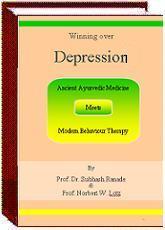 Depression - not primarily in the meaning of our everyday language, but in the clinical sense - is one of the great sufferings of modern life. While mood swings are a normal part of life, depression is a serious disorder that limits the quality of life and suppresses the immune systems.
Depression has been on a steady rise worldwide since the early twentieth century. People suffer from feelings of dejection, low self-esteem, become lethargic and lose interest in what is going on around them. They find it difficult to get motivated, and the consequent reduction of productivity reinforces their perception of inadequacy and insufficiency, and let them feel trapped in a downward spiral.
Depression - in the clinical sense - is an illness that infiltrates your whole body. It affects the way you feel about things, situations and persons, and the way you feel about yourself; it affects the way you eat and sleep, and how your memory is working. Depression, as a mental disease, is going along with body processes, or vice versa. Depression cannot just be blown away, it have to get treated. You need the help of specialists, and then you can start helping yourself.
Depression Ayurvedic Viewpoint
"Ayurveda is inherently a psychological as much as it is a physical system of medicine. Its scope of practice includes both physical (sharirika) and mental (manasika) diseases. Therefore, we cannot really understand Ayurveda without looking at its view of the mind and consciousness." - David Frawley (Light on Ayurveda)Ayurveda mentions Depression as Vishada. This is also described as “most disease aggravating factor”. Although this disease is categorized under psychological diseases, it can also affect the body; hence it can lead to any physical or psychological disorder.
From Ayurvedic perspective, the main causes of depression can be defined as -
imbalance in Kapha and Vata Doshas along with aggravation of Tamas and lack of Sattva quality of mind.
General Line of Treatment Of Depression --
The treatment can be divided in two types
Shodhana - Purification - Depending on the type of Dosha aggravation, specific purificatory procedures should be followed.
Shamana - Pacification - Use of Herbs, Yoga , Pranayama and Sattavavajaya chikitsa - achara rasayana.
Authors -
Prof. Dr. Subhash Ranade & Prof. Norbert Lotz, Ph. D. are the two experts in Ayurveda and Cognitive psychotherapy. Together they
have successfully compiled this complete and comprehensive ebook on Management of Depression.
The authors, Prof. Dr. Subhash Ranade & Prof. Norbert Lotz, are two well-known specialists in the field of two theory- and practice-proven systems and methods: the Ayurvedic Medicine and the Cognitive Behavior Therapy. They know each other since twenty years and now put their knowledge and experience together to write the first book about treating depression by a combination of Ayurveda and Behavior Therapy. The book is a scientifically based, rather compact and highly readable compilation of backgrounds, approaches and case studies.
This great work is very useful for patients, students, practitioners, researchers and for all of you, who are interested in Ayurvedic Science.
Don't miss this unique opportunity.Order Today!
We are offering 'Winning Over Depression' in eBook form!
Because it's in eBook form we are offering it for only US $17.50 (Rs. 215/- only)

 You can make payments with 'PayPal'
Other Payment Mode Options are HERE.
For Indian Residents
Your options to Make Payment in Indian Rupees are HERE.
PAY NOW (Through Instamojo)
ORThrough UPI
Please note - You will not be taken to the download page automatically, after completing your payment.
After receiving your payment information I will send you the download link and password.
Please allow me few hours time for that. Please add our email ID '[email protected]' to your address book (or "buddy", "safe", "approved", or
"trusted sender" lists) to ensure that you will receive replay from us.
Please don't forget to check your 'Junk mail' folder also for our replay.
|
Ebook - Table of Contents
Total pages - 100 |
PAYMENT PROCEDURE
Select the ebooks you want.
Calculate the total price you will require to pay for these ebook.
# You can directly transfer the required amount in my account.
# My account details are as follows:
Bank :- IDBI [Aundh,Pune Branch]
Account Holder:- S.B. Patwardhan(HUF)
Saving A/C No :- 062104000084288
OR
# Deposit any local bank check of required amount in the IDBI bank near you, in my account with details as above.
OR
# You can also Transfer funds from Other Banks to IDBI Bank using Netbanking service and transfer
funds by NEFT.
IFSC Code for IDBI Bank [Aundh,Pune Branch] is - IBKL0000062
Please send your payment intimation to 'editor AT ayurveda-foryou DOT com' along with list of ebooks you have purchased.