
Medicinal herb - Bhuiamla
[Phyllanthus niruri]
BOTANICAL NAME: = Phyllanthus niruri , HINDI= Bhuiamla, SANSKRIT= Bahupatra, Bhumiamalaki , TAMIL= Keezha Nelli
This is a very bitter tasting small shrub that literally means ‘the Amalaki of the earth’ as this very low lying shrub’s leaves resemble the pattern and shape of her somewhat grander namesake- Amalaki (Emblica officinalis). Bhumiamalaki is a very effective liver remedy that is also used for clearing gall and bladder stones
HABITAT: Phyllanthus is an herb common to central and southern India. It can grow to 30–60 centimeters in height and blooms with many yellow flowers. All parts of the plant are employed therapeutically. Phyllanthus species are also found in other countries, including China (e.g., Phyllanthus urinaria), the Philippines, Cuba, Nigeria, and Guam.[1]
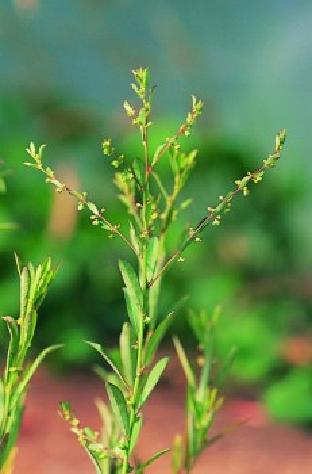 BENEFITS OF BHUIAMLA/ USES OF BHUIAMALKI: Phyllanthus primarily contains lignans (e.g., phyllanthine and hypophyllanthine), alkaloids, and bioflavonoids (e.g., quercetin). While it remains unknown as to which of these ingredients has an antiviral effect, research shows that this herb acts primarily on the Liver. This action in the liver confirms its historical use as a remedy for jaundice. It also takes care of the effective functioning of Liver.
Phyllanthus blocks DNA polymerase, the enzyme needed for the Hepatitis B & C virus virus to reproduce. In one study, fifty-nine percent of those infected with chronic viral Hepatitis B lost one of the major blood markers of HBV infection (e.g., hepatitis B surface antigen) after using phyllanthus for thirty days.[3] While clinical studies on the outcome of phyllanthus and HBV have been mixed, the species P. urinaria and P. niruri seem to work better than P. amarus.[4]
Some studies showed that Bhuiamla (Phllanthus niruri) may help in HIV.[5]
Phyllanthus has been researched for its effects on hepatitis, and in 1988 Thyagaran et al. (ibid) reported that 22 of 37 cases of Hepatitis B lost their "carrier" status after using the herb for a month.
'AYURVEDIC HERBOLOGY'Today while learning and practicing Ayurveda and alternative medicine ; the knowledge of the Healing Herbs described in Ayurveda is very important.
|  We are offering this ebook as an easier way to learn about the medicinal Herbs. We are offering this ebook as an easier way to learn about the medicinal Herbs."Ayurvedic Herbology" is a set of 5 Volumes in E-Book form!! CLICK HERE TO READ MORE AND TO PURCHASE THE EBOOK
If you are interested in doing ----Interactive Online Herbology Course- with certificate from International academy of Ayurveda |
HISTORICAL OR TRADITIONAL USE (may or may not be supported by scientific studies): Phyllanthus has been used in Ayurvedic medicine for over 2,000 years and has a wide number of traditional uses: employing the whole plant for jaundice, gonorrhea, frequent menstruation, and diabetes and using it topically as a poultice for skin ulcers, sores, swelling, and itchiness. It is a very effective liver remedy that is also used for clearing gall and bladder stones The young shoots of the plant are administered in the form of an infusion for the treatment of chronic dysentery [2]
BHUIAMLA DOSES: Research has utilized the powdered form of phyllanthus in amounts ranging from 900–2,700 mg per day for three months.[6]
BHUIAMLA SIDE EFFECTS AND INTERACTIONS: No side effects have been reported using phyllanthus as recommended in amounts above. At the time of writing, there were no well-known drug interactions with phyllanthus.
AYURVEDIC ENERGETICS:
- Rasa (taste) Bitter, astringent, sweet
- Virya (action) Cooling
- Vipaka (post-digestive effect) Sweet
- Guna (quality) Dry, light
- Dosha effect PK-, V+
- Dhatu (tissue) Plasma, blood, fat, reproductive
- Srota (channel) Digestive, reproductive, urinary
NOTES:
- This small shrub grows 60cm high. Its leaves resemble those of Amalaki.
- Numerous studies indicate that Bhumiamalaki from India should be used.
- The species found in India is actually Phyllanthus amarus but it is often erroneously named as Phyllanthus niruri. This variety is actually native to the West Indies and is not found in India.
 REFERENCES:
1. Bharatiya VB. Selected Medicinal Plants of India. Bombay: Tata Press, 1992, 235–37.
2. Nadkarmi KM. India Materia Medica, Vol 1. Bombay: Popular Prakashan Private Ltd., 1993, 947–48.
3. Thyagarajan SP, Subramanian S, Thirunalasundar T, et al. Effect of Phyllanthus amarus on chronic carriers of hepatitis B virus. Lancet 1988: ii:764–66.
4. Meixa W, Haowei C, Yanjin L, et al. Herbs of the genus Phyllanthus in the treatment of chronic hepatitis B: observation with three preparations from different geographic sites. J Lab Clin Med 1995;126:350–52.
5. RASAYANA: Ayurvedic herbs for rejuvenation and longivity by Dr H S Puri, published by Taylor and Francis NY
6. Reichert R. Phytotherapeutic alternatives for chronic hepatitis. Quart Rev Natural Med 1997;Summer:103–8.
RELATED ARTICLE: Ayurveda and Liver Care